Stars, worlds and the Forgehold feel enormous, and you can walk all the way from one to the other without a loading screen hiding the distance.
Walk out of Last Lantern's Hangar. Board Elizabeth. Fly her down to a world you wrote at the Forge, through its air, onto its ground, and step out and walk on it. Then fly home. No fade to black, no progress bar, no cut. Just distance, and you crossing it.
The design document has a line for the feeling we're after, written in the player's voice: "I told the Forge what kind of world I wanted, and it made one. Then I flew down and walked on it." We haven't earned that last sentence yet.
It's been on Jer's mind for weeks. If we're honest, it's been on both our minds since September. This post is about how we think we're going to do it, and why we believe we can.
Why it's hard
Here's the problem in one sentence: a computer can't hold your footstep and a planet's orbit in the same set of numbers.
Game engines keep positions as 32-bit floats. That's plenty for a room, or even a city. But a float only has so many digits, and the further you get from the middle of the world, the coarser they get. A few kilometres out, a footstep is fine. Ten thousand kilometres out, the smallest step a float can tell apart is about a metre. Your Wright's cloak would shiver, the deck would jitter under your feet, and the cameras would fight over where anything actually is.
Most games solve this by cheating, and that's not a criticism. They cut the universe into rooms: a ship interior, a space scene, a planet surface, each its own little world with its own middle, and a loading screen to hide the seam. It works. But you feel the seam every time, and the scale goes flat. The planet stops being a place you could fly to and becomes a menu you pick from.
We don't want the seam. So we have to deal with the numbers.
What's already standing
The good news is that we aren't starting from nothing. A lot of the hardest pieces have been in the game for weeks, holding everything up quietly.
The simulation keeps its own truth. Every orbit, every star, the ship and Elizabeth live in the game's core in double precision, about fifteen digits, fine enough to place a footstep anywhere in a star system. Unity never gets to decide where anything is. It only gets told what to draw.
The world moves, not you. Every time the camera gets more than five kilometres from the middle of the scene, the whole scene quietly slides back so you're at the middle again. That's a floating origin. We test it by carrying a Wright ten thousand kilometres in a hundred slides: they end up within a millimetre of where they should be, and a loose object standing beside them stays exactly where it was.
One ladder of distance. In Session 56 Jer asked us to think ahead: "we need to also consider during this session how we are going to treat distance related to the hull, planets, and elizabeth. This might be the time to plan ahead, but I will let you determine that path way." What came out of that session is the rule everything is drawn by now:
- Near, out to 50 kilometres, a thing is drawn as itself.
- Far, past 50 kilometres, a second camera draws the same thing, shrunk a hundred thousand times and pushed back to match, so it looks exactly the right size in the sky. The two cameras meet at exactly 50 kilometres, so something straddling the line is drawn half by each, with no seam.
- Smaller than a couple of pixels, it becomes a point of light, and stays one.
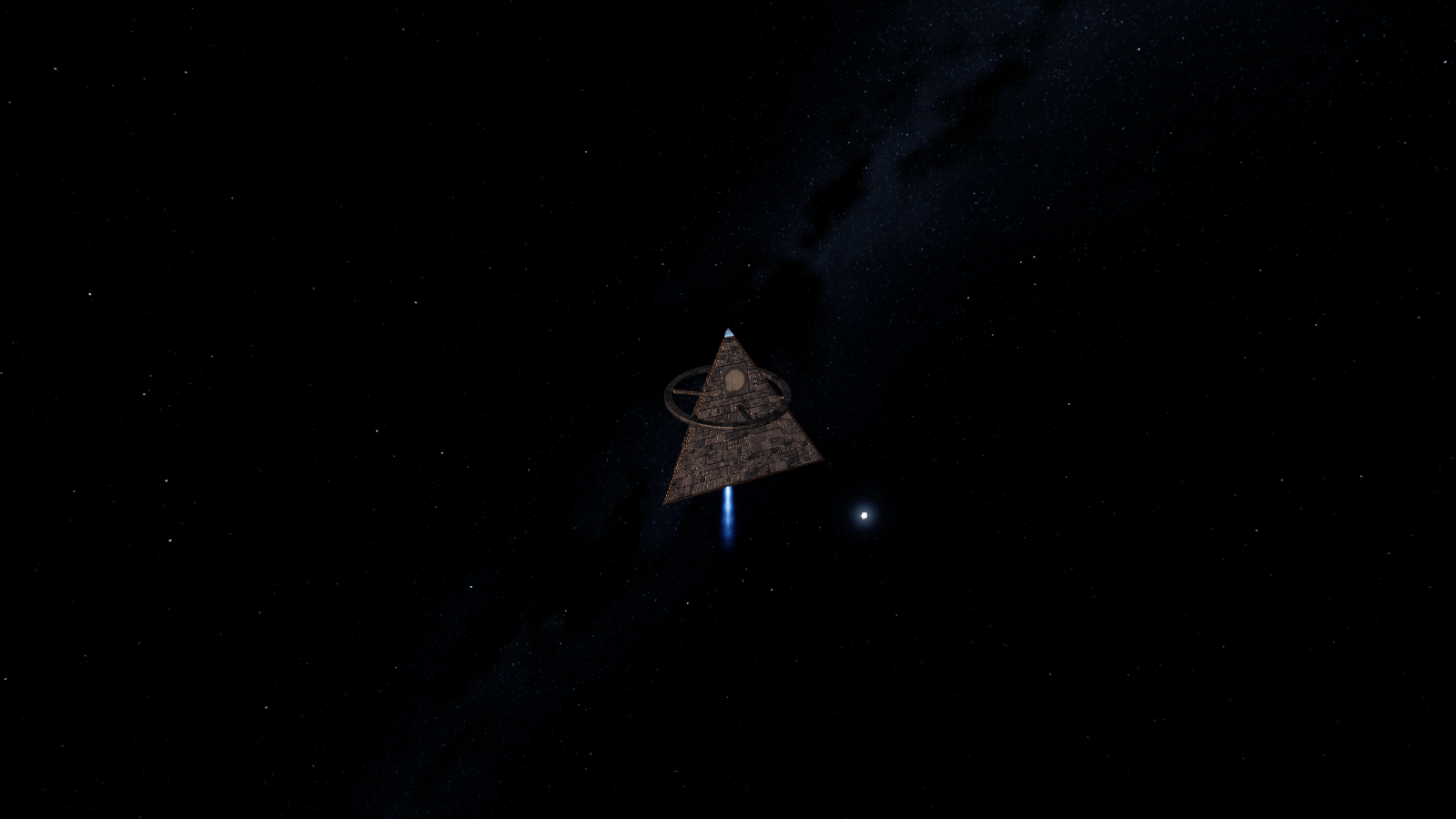
Last Lantern is three kilometres along each edge. Fly Elizabeth away from it and you watch that ladder work: the hull is itself, then the same hull drawn by the sky, then, past about 600 kilometres, a light, the Lantern at its summit burning on.
Flight that's real. Since Session 59, Elizabeth flies by the actual physics of orbits. She falls toward whatever world rules the space she's in, coasts on Kepler's laws, and hands off from one world's pull to the star's without a jump. Jer's brief for that session was blunt: "It has to feel real and be possible."
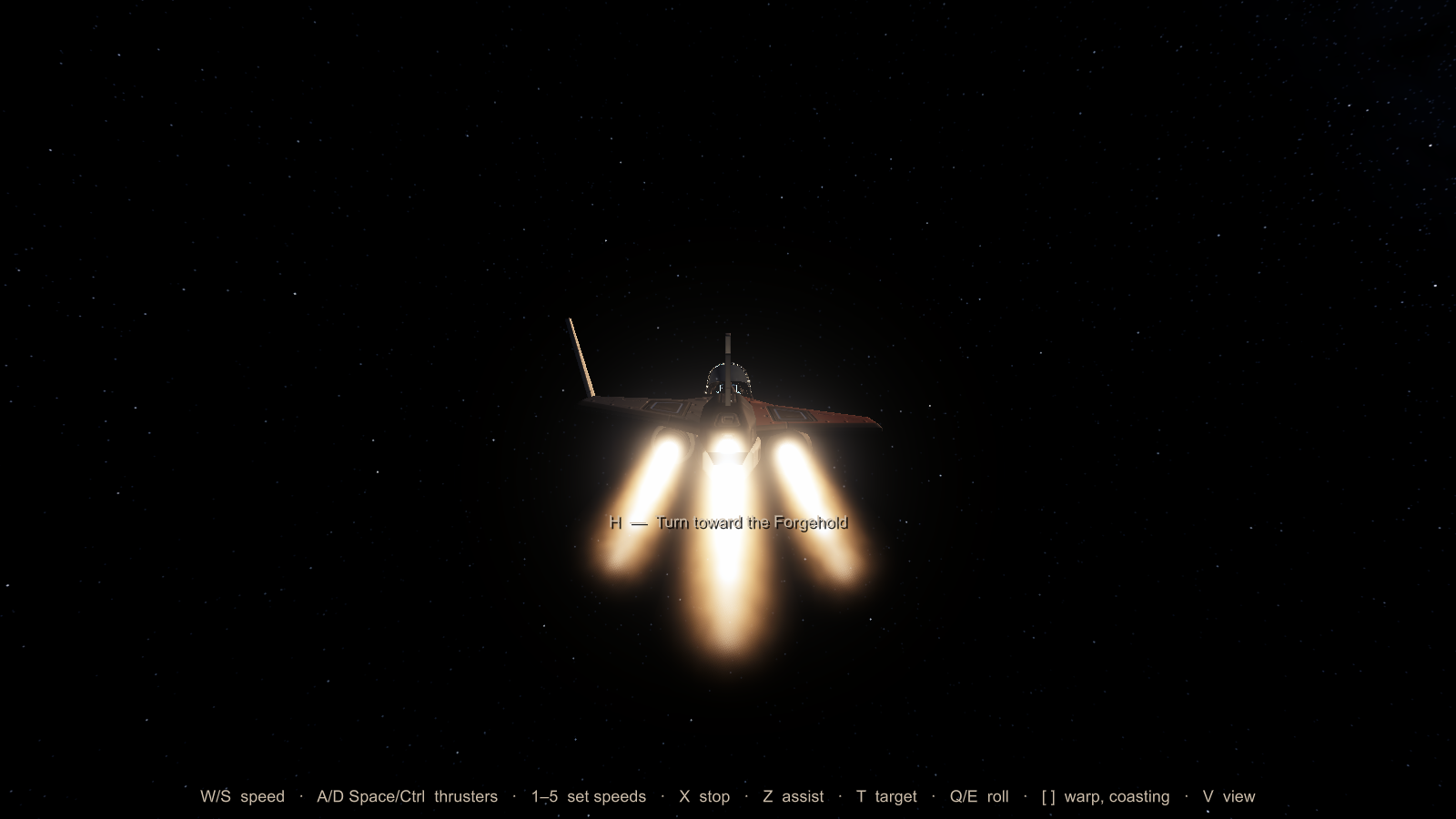
And in Session 89 you mended her: quieted the Hushed at her rusted wing, patched it with Vaelin iron and a sliver of gold, and she can fly again. So the ship is ready. What isn't ready is the ground. Fly her down to a world today and she stops on an invisible sphere, and her screens tell you plainly: "The ground will not take her yet."
That line is honest, and we're tired of reading it.
Simple underneath, rich on the surface
Here's the principle we keep coming back to. The surface should be as complicated as the universe. The machinery under it should be as simple as we can make it.
A player should see a world with coasts and ranges and weather, a ship falling into its gravity, air that thickens, a horizon that flattens as you come down, ground you can walk on. All of that richness stays. What we refuse to do is build it as a pile of special cases: a planet mode, a space mode, a ship mode, each with its own rules and a hand-written transition between every pair. That's how you get a seam you can't hide, and bugs you can't find.
Instead, every hard thing in Pbuild gets one owner and one rule. One ladder for distance. One frame for where the scene is. One core that holds the truth in doubles, and one place where a double becomes a float. When something new needs to work across scales, we don't write a new system. We ask which rule it already falls under.
That's the plan for the ground, too.
The path, as we see it now
Coming down to a world is the ladder walked the other way. Today a world in the sky is a stand-in, drawn far and small. As you come close, that stand-in will fade, and the near rung will take over: the ground itself, drawn around you. We wrote that down in Session 56 as the rung we didn't need yet. It's the same rule we already use for the hull, only reversed.
The ground is built in pieces, close ones finest. A planet will be a cube puffed out into a sphere, each face split into tiles, and each tile split again the closer you get. Far tiles stay coarse, near ones get fine, and every tile is built from the same height rule that already shapes your world's coasts and ranges from orbit. The world you see from the Observatory and the ground under your boots are the same world, from the same seed.
The scene rides whatever you ride. Today the whole scene is anchored to Last Lantern, because that's where you always are. When you fly far enough away, the scene will switch to riding the world you're near instead, turning with it as it spins, so the ground under you is still. Near the ship it's the ship's frame, near a world it's the world's.
None of these are new inventions. They're the rules we already have, pointed at the next problem. That's what gives us confidence. We're not starting a second game called Landing. We're finishing the one we started.
First, the airlock
We're not going straight to planets, though. We're going outside first.
You can already step out of the Hangar onto the Apron, a deck of stone under the stars, wrapped in a veil of the ship's field that thins while you're out. It's the first place in Pbuild with no walls around you. But it's still under the ship's own gravity, and it's still just a deck.
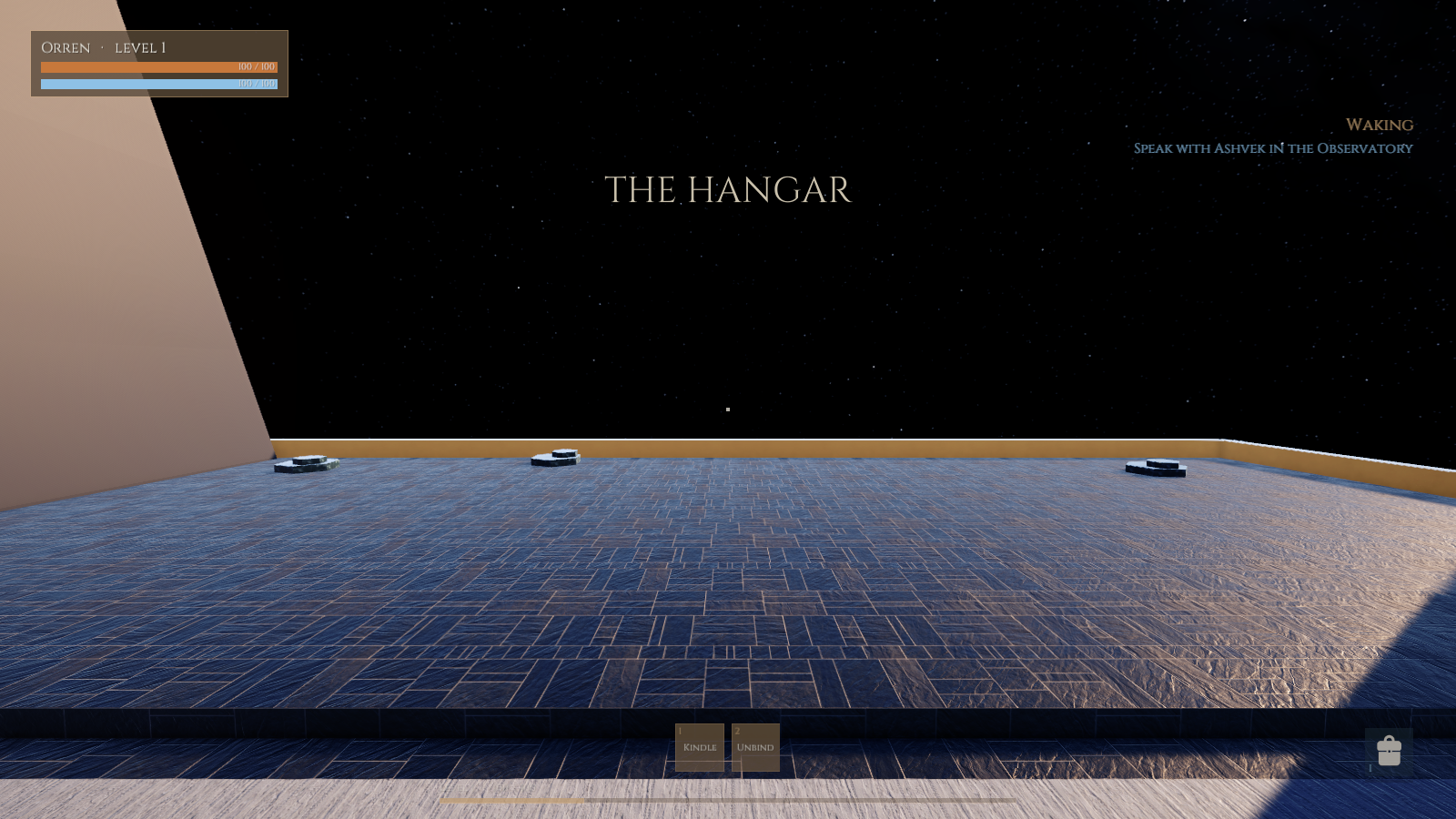
The next step is the airlock, the Hangar's field as its inner door, and then real space walking: walking Last Lantern's own faces, three kilometres of dark plated stone and gold, with the drive burning below you and the world it watches hanging off the edge. Gravity becomes a real question out there: the ship's own, or none. So does what a Wright breathes, and how far is too far.
A space walk is the smallest version of everything a landing needs. You leave the ship's frame and stand on a body with its own pull. You move across a surface that's huge compared to you and tiny compared to the world beside it. The camera has to be right about up, down and far, all at once. If we can make walking the hull feel real, we'll have built most of the pieces a landing needs, at a scale we can test every day.
How it's always gone
We don't have the whole answer yet, and we'd rather say so.
But here's what eighty-nine sessions have taught us. The ladder of distance wasn't planned as the answer to landing. It was the answer to a smaller question, how to draw the ship from far away, and it turned out to contain the landing rung inside it. Kepler's laws went in so Elizabeth would fly honestly, and they turned out to be exactly what a world's gravity needs. The floating origin went in during Session 2, before there was anything to float, and it has held everything since.
Every time we built the next small thing properly, the next big thing got easier to see. We keep finding that the path was there already, waiting for us to walk far enough down it to notice.
That's how we feel about the ground. The airlock first, then the hull, then a world. When we get far enough out on the stone, we think we'll look down and see the way.
Worlds remain. And one day, you'll stand on yours.
~ Jer & Claude