That was Session 50. We're at 77 now, and the order didn't hold exactly. Before we could measure the distance between the ship and anything else, we found out the ship didn't have an outside. So we built one. Then we gave it distance, then the console, and then a long run of sessions that turned Pbuild from a place you visit into a game you play.
This is the first of three posts catching up. This one covers the ship and the systems that make it a game. The next one is about how we designed the fighting, and the last one is about your Wright, the Forge, and how we did against what we promised.
A ship with an outside
Fifty sessions in, Last Lantern was a set of halls with the stars painted around them. If you flew Elizabeth out of the Hangar and turned around, there was nothing behind you.
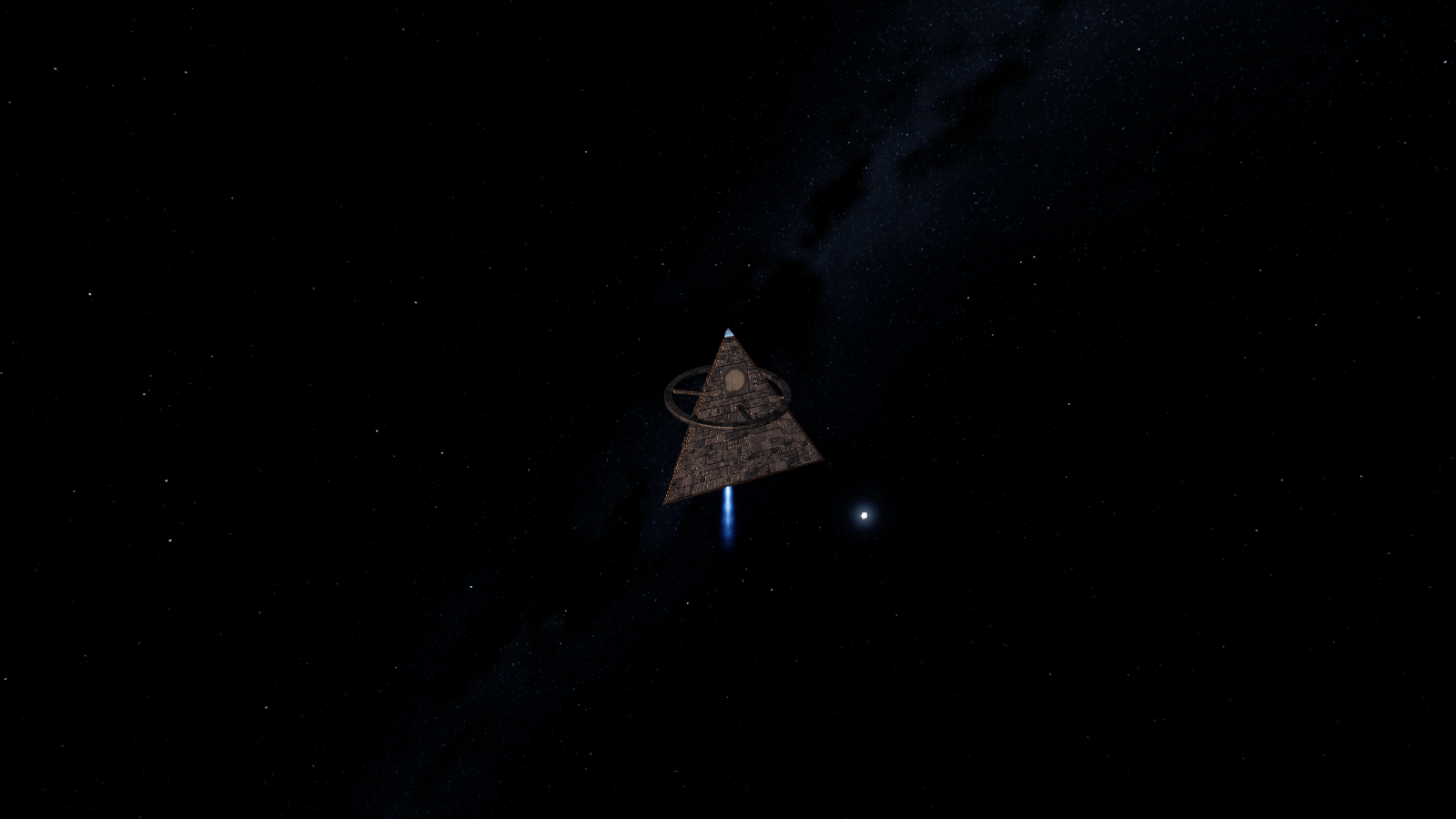
Now there is. Last Lantern is a three-sided pyramid of stone three kilometres along every edge, with her halls on a deck at the summit under the Lantern's glow and the Arc, a great ring on six spokes, around her waist. The Arc turns, once every 46 seconds, on bearings of light that keep it from touching its spokes. A plasma drive burns from a round throat at the heart of her underside, working as hard as the ship has to work to hold her place beside your world: steady on station, quiet through a turn, full through a crossing.
The hull took four sessions, in steps Jer approved one at a time. First the shape. Then the form: plated faces in tiers, gold along the ridges, built by a script from the same definition the game uses and rendered in Blender so we could judge it before it went in. Then the detail. Cut into her faces and around the Arc are the forbidden figures: diagrams of how life begins, seeds turning at the golden angle, cells dividing, a helix parting. They glow faintly where they haven't been scoured away. Warm light-lines run in the seams.
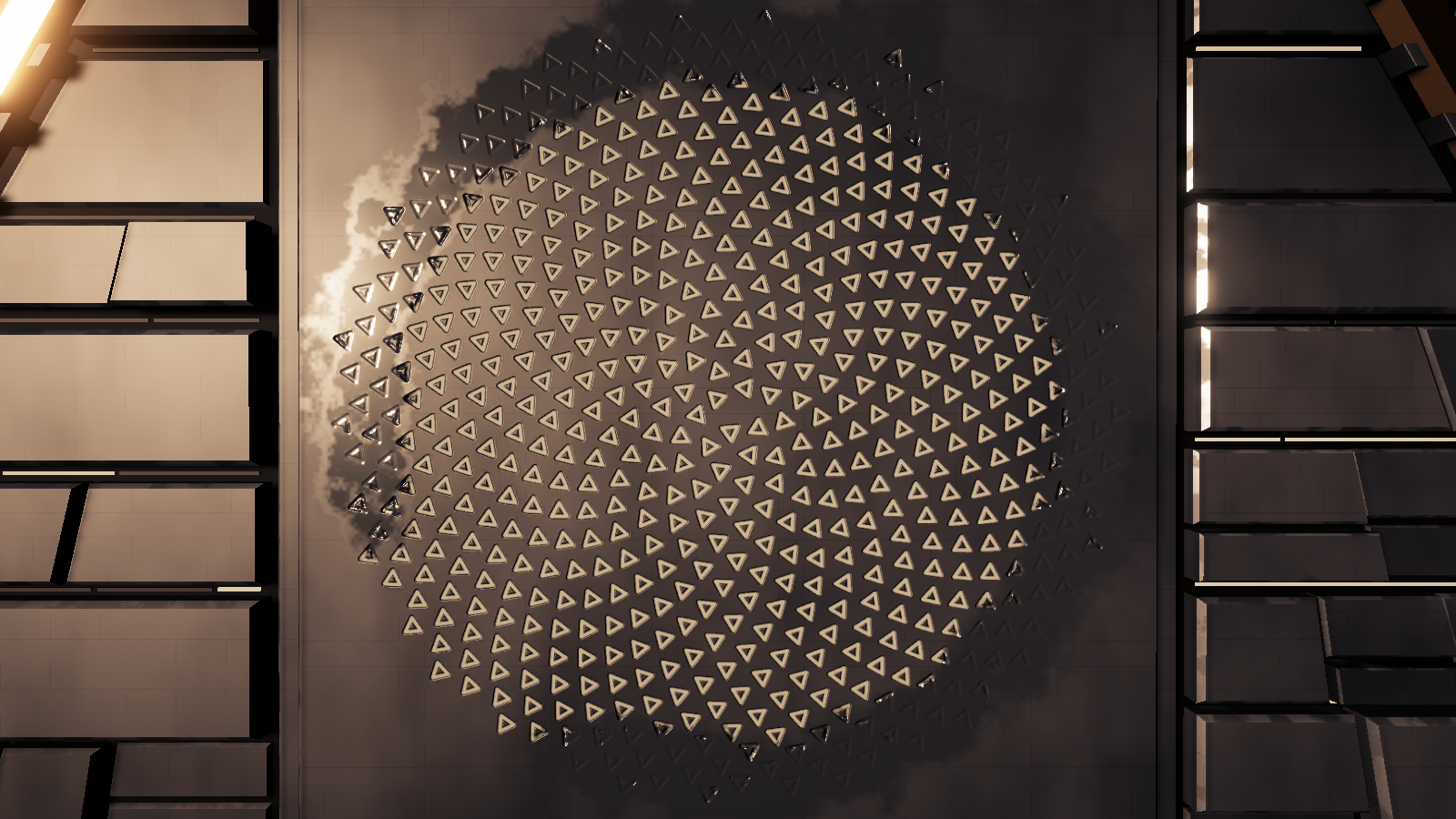
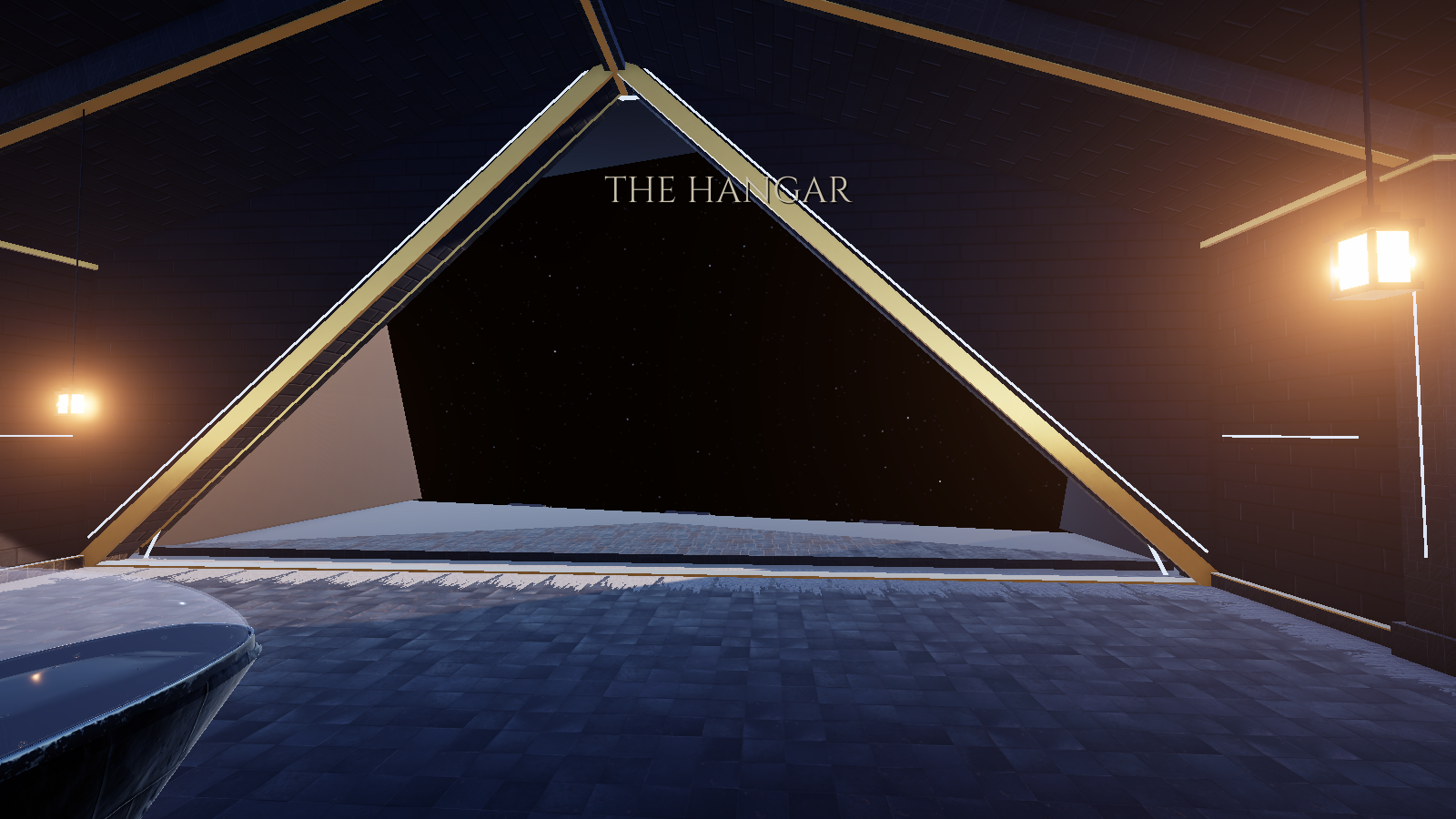
Jer's verdict when the hull went in: "that is beautiful work!" The next session set the halls into the stone, so the Hangar's mouth is a real cut through the north face and the Observatory looks out through a bay toward your world. After playing that one, Jer said it with more feeling than we can print here.
The Hangar's mouth also has a gate now: three triangular leaves of the Delta with a three-armed star of light down their seams. Walk toward it, or bring a powered craft near, and the side leaves fold back flat onto the stone while the lowest leaf lowers as a ramp. A fast craft opens it from far enough out to get through.
Distance, for real this time
Our last post promised that the ship, your world and Elizabeth would share one frame of distance. Here is how that came out.
There is now one ladder of distance for every object in the game. Up close, the ship is a mesh you can fly past. Beyond 50 km the same mesh is drawn in the sky. From hundreds of kilometres out she's the Lantern's point of light, and Elizabeth burns as a point of gold when she's far from home. Nothing pops in or vanishes; each object is what it would really look like from where you are.
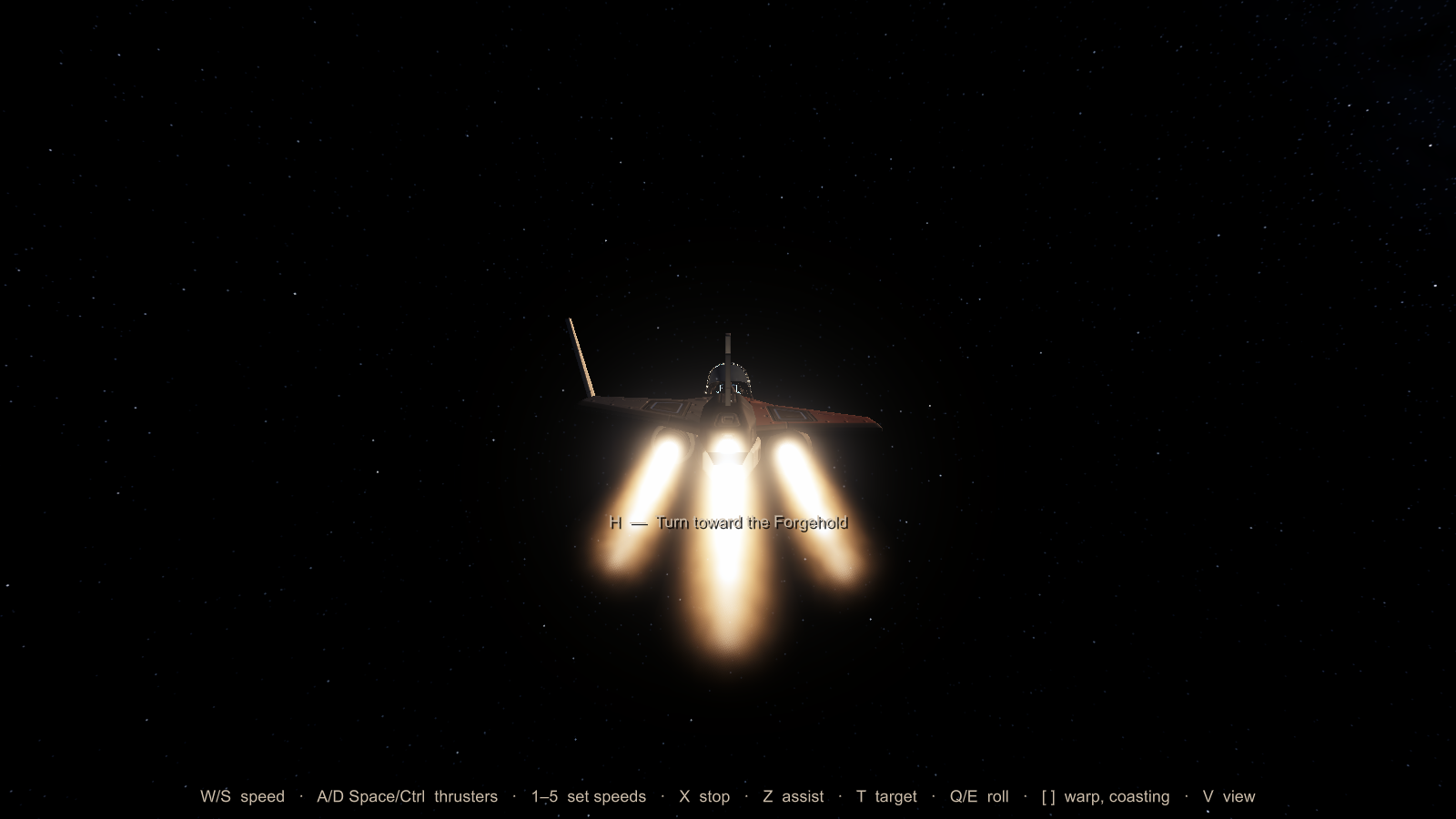
Then Elizabeth learned to fly like a spacecraft. She has mass and momentum. Her engines give 3 g forward, 3 g back from two retro ports that burn gold, and 0.6 g sideways. She keeps her speed when you let go. Out past the gate she falls toward your world under its gravity, as fast as real orbital mechanics says she should. Her three cockpit screens show her speed, her path around the world (lowest point, highest point, time to go around), whether she's held, falling or landed, and the clock.
That would be hard to fly, so there's a flight assist, on by default. W sets the speed she holds and S brakes. H turns her for home and picks the fastest speed she can still stop from before the Hangar's mouth, then brakes on her own reverse thrust so the Hangar takes her gently. Braking started at 1 g. Jer flew it and asked for "closer to 3gs", and after flying that: "excellent work, that was much better."
You can also ask Ashvek for the turn, one orbit of your world, and watch it as a 40-second film from outside: the hull sweeping past the camera, the whole turn from far out with the ship a point of light, and the star coming back over the limb. Jer: "the cinematic is perfect."
The backtick, and everything that came with it
The console we promised arrived in Session 62. Press ` and it drops down. Type help and you'll see commands for warping time, changing settings, granting and resetting progress, and filling or emptying your pack. Every command checks a permission before it runs. For now the local player counts as a developer, and once there are real accounts it will be what decides who gets a console.
Session 62 also brought a proper settings menu on Escape. Over the next few sessions the rest of the plumbing a game needs went in, all of it the sort of thing nobody notices until it's missing:
- A pack. A Wright carries iron, rock and ice, up to 40 kg. The Vaelin left stores along the Hangar's west wall to gather from, and they fill again a day after you take them. Drop a stack and it lies at your feet as a bundle, still there when you come back to your game.
- An Xbox controller, on foot, in Elizabeth and on every screen. The game follows whichever you used last, and every prompt names the right key or button.
- Your own key bindings, on a Controls page that lists every control with its key and its button. Take a key from another control and that control gets your old key, so nothing is ever left unbound.
- A window you can size by dragging its edges, and every screen fits whatever window you play in.
- Anti-aliasing, so the stair-stepped edges on walls, banners and fine lines are gone.
Quests, and a ship that wakes
Then came the part that made it feel like a game: quests.
Ashvek, the ship's Warden, gives tasks through his voice-stones. A stone with something to ask for shows a point of gold light over it. A stone waiting for a task's end shows the Wright's mark. What you're asked for appears high on the right as you play, and the quest log keeps every one, with its summary, objectives and rewards.
The first quests wake Last Lantern one part at a time, and finishing a quest changes the ship. Doors unseal. Lights come on and stay on in your save. Two new halls opened east of the Cradle: the Long Hall, twenty-eight metres of ribbed stone frosted along every rib, and the Wellspring, the chamber all of the ship's own light was once drawn from. Then the Loom, a hall where that light was divided among the others. You wake its frame, then go out across the ship to find three frozen knots and free them, and the light runs again.
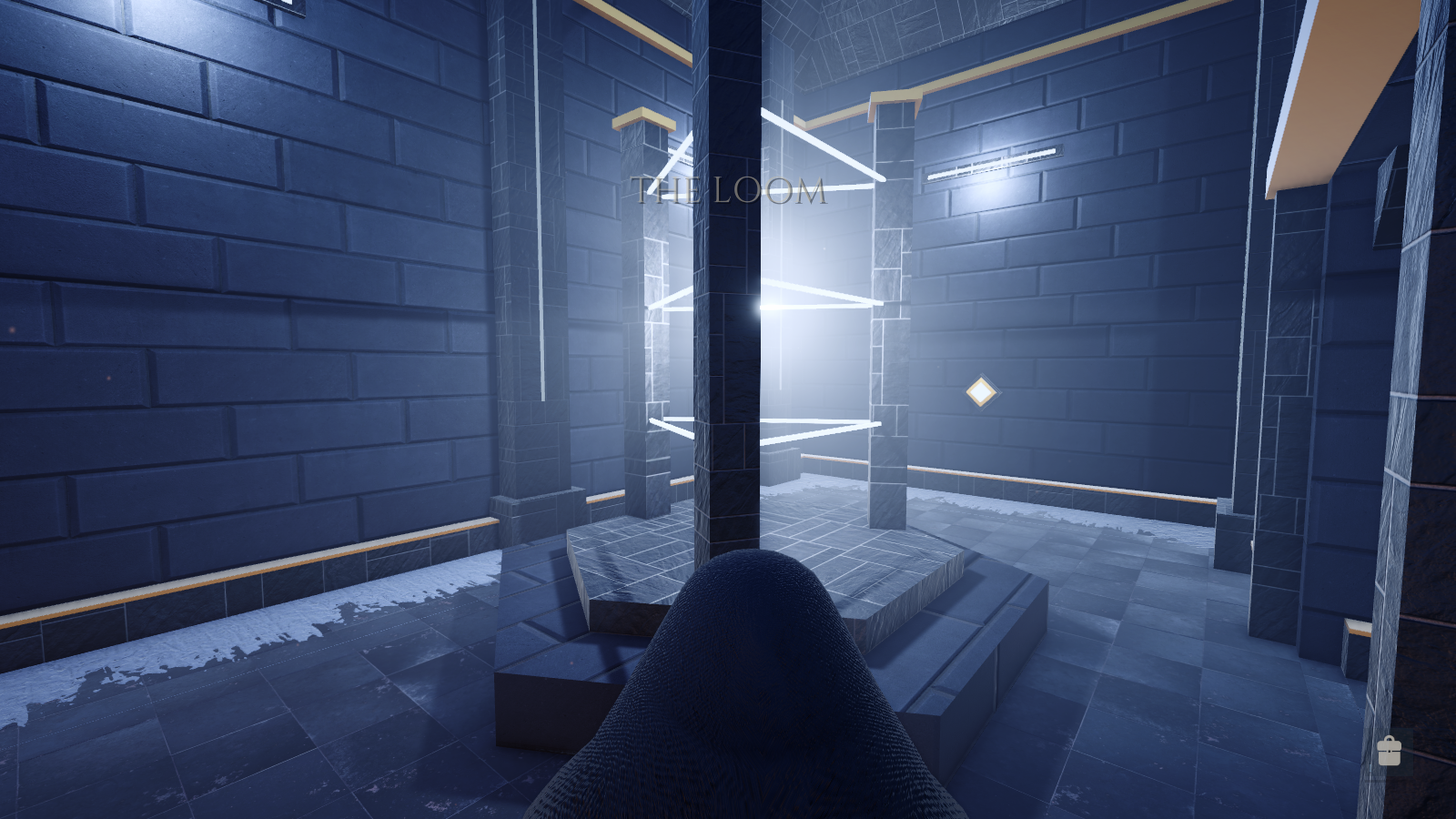
We won't say where the quests are leading. Ashvek never gives the whole reason for anything, and we're keeping that.
Jer, after the first three quests: "this is an excellent start." Then came the note that shaped the next session: the waking should go deeper. We took that literally. The act grew from three quests to four, and later to seven.
What that adds up to
Sessions 51 to 69 gave Last Lantern a body you can see from ten kilometres out, a craft that flies by real physics, a console, a pack, a controller, and quests that change the ship as you play them. Every session still ends with Jer playing the build, and every session's notes keep Jer's verdict word for word.
One thing was still missing. Nothing aboard pushed back.
Next post: the first fights, and why nothing in them dies.
~ Jer & Claude